What you should see
An even grey speckle over the full inner surface, running cleanly up to the reinforcement rings, with no bare wood showing under the mount plate.
Documented
In 1974 Hoshino Gakki retired the Star name and put Imperialstar at the head of the new Tama catalogue. What arrived was not a copy of an American drum. It was a Japanese manufacturing argument: bonded wraps instead of seamed ones, a grey speckled interior coat applied to every shell, an internal muffler as standard, and hardware built to survive a working year on the road.
Triple-flanged chrome hoops through most of the run. Die-cast hoops appear on some later and higher-specification drums; hoop type alone does not date a shell.
Turn the drum over before you look at anything else. The grey speckled interior coating is the most reliable single characteristic of a period Imperialstar, and the hardest to fake convincingly.
An even grey speckle over the full inner surface, running cleanly up to the reinforcement rings, with no bare wood showing under the mount plate.
Overspray into hardware holes, a coat that stops short of the edges, or a glossy modern paint sitting over the original texture.
The coating was used across the run. Its presence supports the era. It does not narrow the year, and it does not confirm that the hardware on the shell is original to it.
Tama's reputation was built on the metal around the drum. Hardware is therefore the most useful evolution signal on an Imperialstar — and the least reliable proof of originality, because hardware is what working drummers replaced first.
Lighter mounting hardware inherited from late Star practice; foil badging.
Consistent withHeavier holders and metal badging appear as the line matures.
Consistent withDeeper tom formats and the heaviest mounting hardware of the original period.
DocumentedDrawn in the manner of a 1970s Japanese export catalogue: a single outfit, flat lighting, and annotations set in the margin rather than over the instrument.
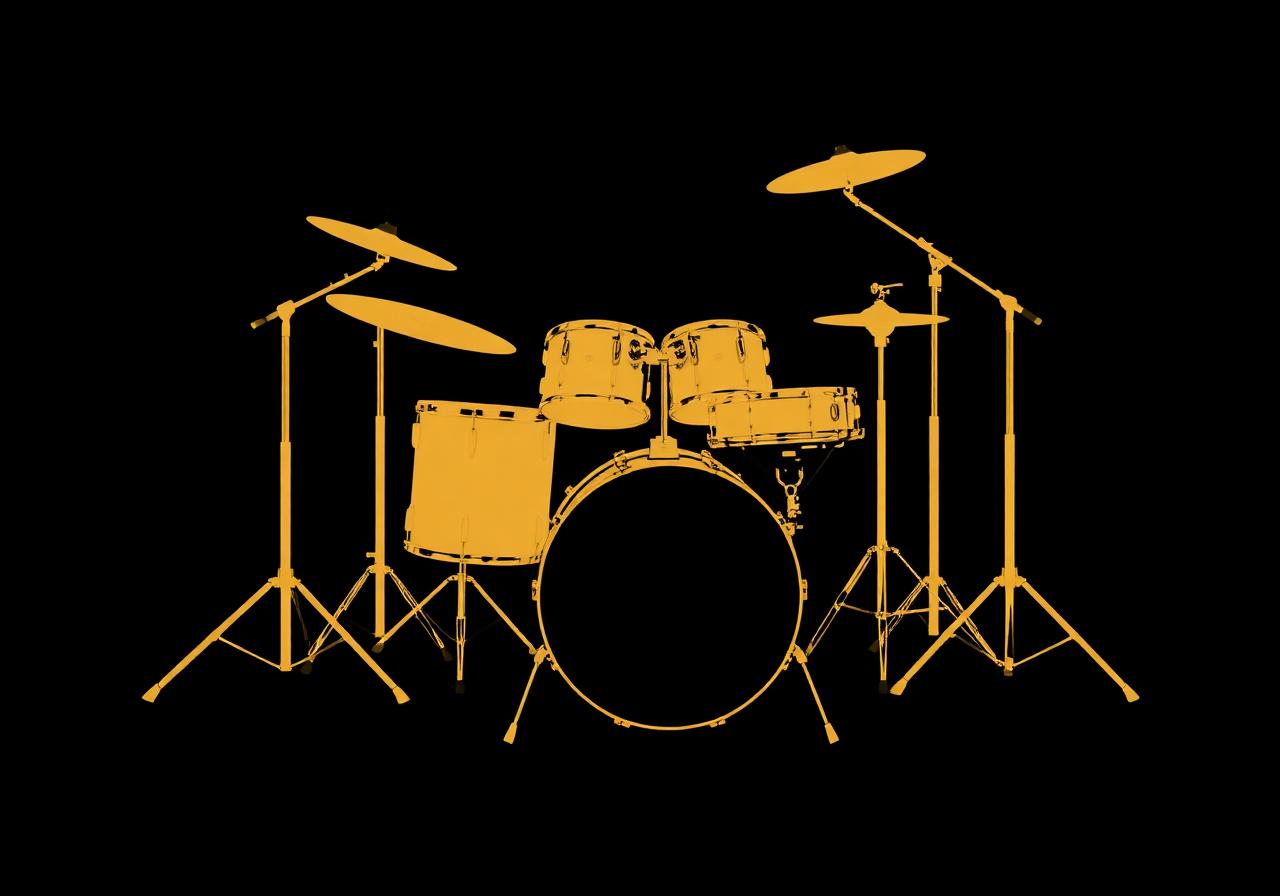
The period-typical club and studio setup. The configuration most surviving kits are found in.
The standard catalogue outfit through most of the run.
Offered in larger catalogue outfits. Frequently assembled later from separate kits.
Deeper tom formats become common later in the run. Depth alone does not date a drum.
Wrap availability varied by year and market. These swatches are editorial approximations of surviving examples under neutral light — not manufacturer colour references.
The default roadworthy finish. Shows lacquer-like depth under stage light.
Ages to warm ivory. Under-lug colour is the reference for original tone.
Deep, restrained red rather than a bright modern hue.
Cool, dark. Frequently mistaken for black in poor photographs.
Sparkle wraps read very differently in daylight and tungsten.
Common survivor. Check for wrap shrinkage at the edges.
No single feature dates an Imperialstar. Work through the drum in this order and record what each observation supports rather than what it proves.
LookGrey Zola-Coat speckle across the full inside surface, including under the mount plate.
ReadA clean, even interior coat is strong supporting evidence for the period. Overspray onto rings or hardware holes suggests a refinish.
LookBadge style, fixing method, and whether the vent grommet matches the badge era.
ReadBadge narrows an era window. A badge inconsistent with the interior, wrap and hardware points to a swap, not a rare variant.
LookPlating age, lug casting profile, screw heads, and washer material across every lug.
ReadUniform wear across all hardware is the point. One bright lug in a set of eight is a replacement.
LookBond line, shrinkage at the bearing edges, and colour under the lug plates.
ReadColour under hardware is the original colour. Heavy divergence from the exposed surface means UV ageing, not a different wrap.
LookExtra holes, filled holes, mismatched hoops, modern mounts, aftermarket mufflers.
ReadExtra holes are permanent. Price accordingly and describe them plainly — a working kit with honest modifications is not a fake.
LookDo the drums share interior tone, wrap batch, badge era and hardware generation?
ReadMany surviving kits are assembled from several drums. That is common and not dishonest — but it must be stated.
Supported by a dated primary source — a catalogue, price list, or period advertisement.
Matches the pattern seen across surveyed examples, but no dated primary source fixes it.
Commonly encountered as a later change, a parts swap, or a kit assembled from several drums.
Repeated widely in the collector community without a source we can point to. Treat with care.
Read this as tendency, not as a dating table. Transitions were gradual, overlapping, and different by market.
| Earlier production | Later production | Evidence | |
|---|---|---|---|
| Badge | Foil, Star-era tooling | Metal, black and gold or oval | Consistent with |
| Tom mount | Lighter single-post holder | Heavier multi-point holder | Consistent with |
| Tom depths | Standard depths | Deeper power formats offered | Documented |
| Hoops | Triple-flanged | Triple-flanged; die-cast on some drums | Consistent with |
| Interior | Grey Zola-Coat | Grey Zola-Coat | Documented |
| Catalogue position | Premium line at the rebrand | Sits below Superstar and Artstar | Documented |
Original interior, matched hardware generation, an un-drilled shell, and a wrap without shrinkage. A complete matched kit is worth considerably more than the sum of its drums — but we do not publish price figures we cannot source.
There is no published serial-to-year table for this period. Anyone offering an exact build year from a serial number alone is interpreting, not reading a record.
Imperialstar was revived decades later on entirely different instruments. A modern Imperialstar is not a vintage one, and the two should never be compared on the name alone.